Infrared vs Traditional Sauna | Summit Wellness Saunas
Choosing between an infrared sauna and a traditional sauna usually comes down to three things:
-
The type of heat you prefer
-
The electrical setup your home can support
-
How much space you have
Both can work well in a home wellness setup, but they feel different and have different installation requirements.
Quick Answer
Choose a traditional sauna if you want the classic high-heat sauna experience and are comfortable with a higher-voltage electrical setup.
Choose an infrared sauna if you want a lower-temperature indoor sauna that may be easier to place in a smaller residential space.
Neither is automatically better. The right choice depends on your home and how you plan to use it.
How Traditional Saunas Work
Traditional saunas heat the air inside the room using an electric or wood-fired heater.
The heated room creates the familiar sauna environment most people associate with traditional sauna use.
Traditional saunas are often a good fit for buyers who want:
-
Higher room temperatures
-
A classic sauna experience
-
Indoor or outdoor options
-
Larger seating layouts
-
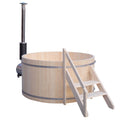
Barrel or cabin-style designs
How Infrared Saunas Work
Infrared saunas use infrared heating panels that warm the body more directly instead of relying primarily on very hot room air.
They generally operate at lower room temperatures than traditional saunas.
Infrared models are often a good fit for buyers who want:
-
Indoor installation
-
Compact one- or two-person options
-
Lower operating temperatures
-
Modern controls and features
-
Straightforward everyday use

Temperature Differences
Traditional saunas typically operate at higher room temperatures than infrared models.
For example, the Logan 1-Person Traditional Sauna in the Summit Wellness catalog can reach temperatures up to approximately 195°F.
By comparison, the Barcelona FAR Infrared Sauna operates at temperatures up to approximately 140°F.
That difference changes the overall experience.
A traditional sauna feels hotter in the room, while an infrared sauna provides warmth at a lower ambient temperature.

Electrical Requirements
This is one of the most important practical differences.
The Barcelona 1-to-2 Person FAR Infrared Sauna uses a 120V dedicated 15-amp outlet.
The Logan 1-Person Traditional Sauna uses 240V at 30 amps with a 6kW heater.
That means an infrared sauna may work with a simpler residential electrical setup, while many traditional sauna models require a dedicated higher-voltage circuit.
Always check the exact electrical specifications before ordering.
Installation Differences
Infrared saunas are usually intended for indoor use and often have a relatively compact footprint.
Traditional saunas can be installed indoors or outdoors depending on the model.
Outdoor traditional saunas may require:
-
A level base
-
Weather protection
-
Electrical planning
-
Delivery access
-
Additional installation preparation
Traditional saunas can therefore involve more site preparation, especially for larger outdoor models.
Space Requirements
Infrared saunas often work well in smaller spaces.
A compact infrared sauna may fit in:
-
A home gym
-
Spare room
-
Finished basement
-
Large bathroom
-
Dedicated wellness room
Traditional saunas are available in both compact and larger formats, but bigger models may require significantly more floor space.
Before buying, compare the actual dimensions rather than relying only on the advertised person capacity.
Real Example: Barcelona Infrared Sauna
The Barcelona 1-to-2 Person FAR Infrared Sauna is a compact indoor model.
Key specifications include:
-
Approx. 39" × 36" × 73"
-
One- to two-person capacity
-
120V
-
Dedicated 15-amp outlet
-
Six infrared carbon heating panels
-
Maximum temperature around 140°F
This type of model may appeal to buyers who want a smaller indoor sauna without installing a higher-voltage traditional heater.
Real Example: Logan Traditional Sauna
The Logan 1-Person Traditional Sauna offers a different experience.
Key specifications include:
-
Approx. 4' 5½" wide × 3' deep × 6' 8" high
-
One-person capacity
-
6kW Harvia electric heater
-
240V
-
30 amps
-
Maximum temperature up to approximately 195°F
Although it is compact, the Logan still requires a higher-voltage electrical connection because it uses a traditional sauna heater.
Real Example: Charleston Traditional Sauna
The Charleston 4-Person Traditional Sauna provides more interior space and a double-bench layout.
It is designed for indoor use and uses a 6.0kW Harvia heater with a 220V electrical supply.
This type of sauna may be better suited for couples or families who want more room to sit or stretch out.
Which Is Easier to Install?
In general, a compact infrared sauna may be easier to install when:
-
You already have an appropriate indoor location
-
A dedicated 120V circuit is available
-
You do not need outdoor site preparation
A traditional sauna may require more planning when:
-
A 220V or 240V circuit is needed
-
The unit is larger
-
It will be installed outdoors
-
Professional electrical work is recommended
Installation requirements vary by product, so always review the exact specifications before purchasing.
Which Is Better for Small Spaces?
Infrared saunas often have an advantage in smaller indoor spaces because many models are designed for one or two people.
However, compact traditional saunas are also available.
The better question is not simply “Which type is smaller?”
Instead ask:
-
What are the exact exterior dimensions?
-
How much clearance is required?
-
How will the door open?
-
What electrical connection is needed?
-
Will one or two people use it?
Which Is Better for Outdoor Use?
Traditional saunas generally offer more outdoor options, including barrel and cabin-style models.
Infrared saunas are more commonly designed for indoor residential environments.
If your goal is a backyard wellness space, an outdoor traditional sauna may give you more choices.

Which One Should You Choose?
A traditional sauna may be the better fit if you:
-
Want classic high-temperature sauna heat
-
Prefer indoor or outdoor options
-
Want a barrel or cabin-style sauna
-
Have the electrical capacity for a higher-voltage heater
-
Want a larger seating layout
An infrared sauna may be the better fit if you:
-
Want a compact indoor sauna
-
Prefer lower room temperatures
-
Want simpler electrical requirements
-
Have limited space
-
Prefer modern controls and features

Final Comparison
The right sauna depends less on which technology is “better” and more on which one fits your home.
Before choosing, compare:
-
Heat style
-
Maximum temperature
-
Electrical requirements
-
Installation location
-
Available space
-
Seating capacity
-
Indoor vs. outdoor use
-
Features
-
Total setup cost
For a broader overview, read our Home Sauna Buying Guide.
You can also explore:
-
Traditional Saunas
-
Infrared Saunas
-
Barrel Saunas
-
Cold Plunges